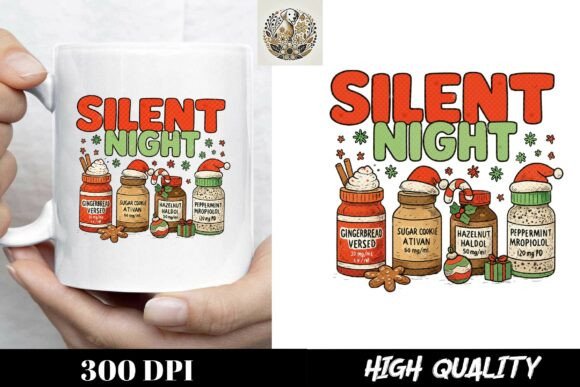
Silent Night Christmas ICU Nurse Life
A Designer’s First Look: Warmth, Wit, and Wearable Heart
When Silent Night Christmas ICU Nurse Life landed in my inbox, I paused—not because it’s flashy, but because it *lands*. It’s quiet confidence in vector form: a gentle holiday nod layered with deep professional respect. The composition balances soft script (“Silent Night”) with clean, grounded lettering for “ICU Nurse Life,” anchored by subtle Christmas motifs—think tiny stars or minimalist holly, not glitter bombs. It doesn’t shout; it smiles knowingly across a hospital hallway at 3 a.m. That tone is its strongest asset—and its biggest design responsibility.
Where This Design Truly Shines (and Why)
I recently prepped a batch of custom embroidered tote bags for a local nurse appreciation event—and Silent Night Christmas ICU Nurse Life was my top pick for the front panel. Why? Because it reads clearly at 4.5 inches wide, holds up beautifully on medium-weight canvas, and feels personal without being overly sentimental. It worked just as well scaled down to 3.25 inches on baby onesies (for NICU staff families) and up to 5.75 inches on heavyweight sweatshirts sold at a boutique pop-up.
This isn’t just a T-Shirts graphic—it’s a handmade product anchor. As a machine embroidery design, it leans into satin stitch for lettering and delicate fill stitch for icons, avoiding dense clusters that could stiffen fabric. I’ve used it successfully on aprons for nurse-led cooking classes, tea towels gifted during holiday shifts, and even as an embroidered patch sewn onto lab coat pockets. Its strength lies in clarity, restraint, and emotional resonance—not complexity.
Fabrics & Fit: Where Caution Meets Care
Let’s be direct: Silent Night Christmas ICU Nurse Life performs best on stable, medium-to-heavy fabrics. On thin cotton tees? I recommend testing with light tear-away stabilizer—and skipping the smallest text elements unless you’re using high-thread-count fabric and sharp needles. Stretchy knits (like jersey or lightweight French terry) need cut-away stabilizer underneath *and* topping for crispness, especially around curved edges like the “N” in “Night.”
Dark fabric? Absolutely viable—but only if your thread colors offer strong contrast. I ran a black-on-navy version on a holiday sweatshirt and swapped to metallic silver thread for the star accents; it elevated the whole piece without looking costumed. For caps or curved surfaces, keep the design under 4 inches wide and avoid tight corners—the script “Silent Night” flows best on flat or gently contoured areas like front panels or pillow covers.
Stitch Density & Detail Reality Check
This embroidery file uses thoughtful stitch density—not too sparse (which risks fraying), not too heavy (which adds bulk and wear risk). That said, the small decorative elements (like holly berries or star points) demand attention. Before stitching on client garments, I always inspect those details in my embroidery software. If they’re under 0.8 mm in any dimension, I’ll simplify or omit them for baby embroidery or frequently washed kitchen towels. Running stitch outlines help define shapes without adding weight—a smart touch for a digital embroidery file meant for real life.
Commercial Use: Trust, Tone, and Tiny Print
As an Etsy seller and craft business owner, I vet every design asset for brand alignment and buyer trust. Silent Night Christmas ICU Nurse Life earns credibility because it avoids cliché. No stethoscopes shaped like candy canes. No cartoonish snowmen holding IV bags. It respects the profession while honoring the season—making it ideal for boutique branding, personalized gifts, and small shop merchandise where authenticity matters more than volume.
That said: always confirm licensing before listing finished products. Since the product description states it’s “carefully created to help you,” assume commercial use is intended—but verify whether redistribution of the digital embroidery file itself is permitted. I never list a ready-made embroidered pillow cover without first checking if the license covers resale of physical items. Clarity here protects your craft business and your customers’ expectations.
Practical Designer Notes You’ll Actually Use
- Test first—on scrap fabric matching your final project’s weight and stretch.
- Check thread color contrast in natural light—not just on screen. What looks bold in mockups may fade on oatmeal linen.
- Review stitch density in your embroidery software: look for long satin runs or tight fills that might pucker.
- Confirm hoop size—this design fits comfortably in a 5x7 hoop, but double-check before hooping expensive garments.
- Inspect small details manually: tiny stars, dot accents, fine serifs. If they vanish on test stitching, simplify.
- Test black-and-white mockups—they reveal hierarchy and legibility faster than color previews.
- Compare light/dark backgrounds side-by-side. Some letterforms gain warmth on cream; others pop on charcoal.
- Use proper stabilizer: cut-away for knits, tear-away for stable wovens, fusible for lightweight linens.
- Ask yourself: does this feel like something a nurse would *choose*—not just tolerate—as part of their holiday identity?
Final Thought: More Than a Graphic, Less Than a Gimmick
Silent Night Christmas ICU Nurse Life won’t win awards for technical fireworks—but it’s the kind of embroidery project that earns repeat orders, heartfelt thank-you notes, and quiet pride in your portfolio. It’s designed for people who value meaning over mass, care over clutter, and craftsmanship over convenience. Whether you’re stitching a last-minute holiday gift for a colleague, building a cohesive line of nurse-themed apparel, or sourcing reliable design assets for your Etsy shop, this one earns its place—not because it’s perfect, but because it’s *considered*. And in embroidery, considered is everything.